|
|
Michelle Goldberg, author of a recent book on reproductive rights "The Means of Reproduction: Sex, Power, and the Future of the World," has an article in the LA Times that summarises the complex arguments made in her book. Both address the conundrum that the world faces twin crises in its demographic future: soaring birth rates globally, with the great majority being amongst the poorest members of the poorest countries, and plummeting birth rates in several leading developed countries, notably Italy, Japan, Spain and Russia. It may seem crazy to assert at first that both problems are the result of women's lack of reproductive and economic freedom, but the arguments are pretty strong. This book is in my Wish List . .
Here's an excerpt from the article:
Some social conservatives are using the threat of rapid First World population decline to argue for restrictions on women's rights. But that gets it precisely backward. In developing countries, lower social status for women is associated with higher fertility, but once societies become highly industrialized and women taste a certain amount of freedom, the reverse is true.
Fertility is reaching dangerously low levels in countries where social attitudes and institutions haven't caught up with women's desire to combine work and family. When faced with men who are unwilling to share domestic burdens, inflexible workplaces and day-care shortages, many women respond by having fewer children or forgoing motherhood altogether.

It's not looking good for the honeybees. So far, experts have not found evidence of CCD (Colony Collapse Disorder) but there has been a massive rise in honeybee deaths this past winter and spring. Honey shortages are expected. But it's more than honey, you know. The shift from food crops to bio-fuel corn and wheat leads to food shortages for humans, but also to pollen shortages, which means bees die off, which means they aren't around to pollenate fruits and vegetables which leads to reduced yields of other food crops. It sets up a feedback cycle, a race to the bottom. The most pessimistic scientist-experts say frightening things, like all the bees could be gone in ten years, and humanity cannot survive ten years beyond the extinction of bees.
In the NYT Magazine for last Sunday, Michael Pollan, author of In Defense of Food - An Eater's Manifesto (in the UK published as In Defence of Food - The Myths of Nutrition and the Pleasures of Eating) has written a really brilliant comment piece called "Why Bother?". He poses the question that so many pose, and then immediately give up - in the face of the enormity of environmental peril and climate change: how can my actions possibly make a difference? Pollan says his heart sank when at the end of Gore's film, An Inconvenient Truth, his exhortation is for everyone to change their light bulbs. (Yeah, that really does bite. Thanks for that, Al.) After making a rather weak appeal (in my opinion, but I guess one does have to choose ones words, and the article is already four pages, very economically worded) to out-of-fashion concepts like virtue and community, he turns to the even more out-of-fashion Wendell Berry, a man with whom we should all be (but possibly some of us are not) familiar. Berry was the originator of the "cheap-energy mentality" critique. This is getting more to the heart of the matter, as Pollan points out that it is cheap energy, the division of labour, and the resultant atomisation of communities that both contributes massively to global warning and at the same time, makes changing our ways so impossible, and even impossible to think about or understand.
Then, thankfully, after laying out the utter hopelessness of the case, he turns to hope. You can only do what you can do, and he does give reasons why we should do it. So the task now is to decide - what is the most effective thing to do, the most urgent, and also fully within the realm of possibility? (Hint: it's not light bulbs, it's not "carbon offsets" and it's not writing a cheque or joining a club.) The answer is to grow your own food. Yep, just exactly what all us hippies said to do way back in 1970. Damn shame we were all too high to make a coherent point.

After having had to listen to my pro-kudzu rant (I am the eternal champion of despised vegetables and animals) my son simply put this link in a comment to my only blog from Atlanta.
But I am sure there is a dramatic difference in the appearance from the air of Atlanta, and not an improvement, which perhaps only accidentally coincides with the kudzu-abatement programme. And yes, I do miss the kudzu.
I can remember when Minneapolis police were famed for their sensitive handling of political protests. Those days are long gone. A regular event in the protest calendar is "Critical Mass", when an assembled group of cyclists take to the city streets, usually at rush hour, to assert their rights to equal use of the roads. This Friday, it suddenly became ugly. Given the tenor of this quote, from before the incident that led to the arrests, I don't think it was the protestors who caused it either:
"Drive down Nicolet, herd the assholes down there. Any blocking of traffic, any blocking of anything, arrest them."


I have been following this story about wildfires in Greece. It is becoming very serious. There are real fears that along with property and lives that are being lost each day, the fires are threatening to destroy ancient sites of great importance. Fires are raging in half the country and the fire services are not even close to equipped to cope with the scale of the disaster.
 My new m.o. for Wednesday Website of the Week is to start on Friday and work my backwards. So this one is only one day late, a 100% improvement on last week! This week's WWW is not a site exactly but a theme, a film coming out in a little over a week which is a fictional tale of London in a disastrous flood. My new m.o. for Wednesday Website of the Week is to start on Friday and work my backwards. So this one is only one day late, a 100% improvement on last week! This week's WWW is not a site exactly but a theme, a film coming out in a little over a week which is a fictional tale of London in a disastrous flood.
In 1984 the Thames estuary southeast of London inaugurated a system of flood defence in the form of the massive Thames Barrier. It is the second largest flood barrier in the world, exceeded in size only by one in the Netherlands called the Oosterscheldekering. The film concerns a tsunami surging up the estuary and breaching the barrier (a scenario that the experts say is extremely unlikely but hey if it makes a good movie . . . )
It is a little uncanny that as this film was being made, floods of a fairly disastrous type were hitting Britain in real life, even if there was no tsunami involved and London was barely affected. Meanwhile, monsoon floods have claimed hundreds of lives in south Asia. And if it's not water, it's fire: I just saw the most appalling footage on the TV news of a towering inferno sweeping through suburban Athens (Greece, not GA) propelled by gale force winds.

In the course of jazzing up my customised Google home page, I added a feature called Mood News that was supposed to be a newsfeed of only good, uplifting, positive news. It didn't work at all and I had to delete it; it was just giving me the same old depressing news as any feed only more weird and random. But I serendipitously found this piece of lovely upbeat news - about a terribly depressing subject too - on the newsstand in the W. H. Smith at Leicester train station.
When this was originally reported earlier this morning, there was a claim that no "nuclear material" was in danger of being released. Now it appears that some radioactive water was released into the sea. True, it is apparently of negligible danger, but the thing is, every time there is a nuclear accident, the first news out is always absurdly positive, and the real truth takes from hours to months to make it to the surface. It does make one cynical.
Weekly Grist is a "tree-free" (that is, online only) weekly environmental magazine, and they have hit upon a very clever fund-raising strategy. They are selling officially authorised Indulgences which can be offset against any environmental sin. And, unlike the original, pre-Reformation catholic church indulgences, they can be purchased on the installment plan, so they are not only available to those who have loads of dosh (which of course you get by committing more sins.)
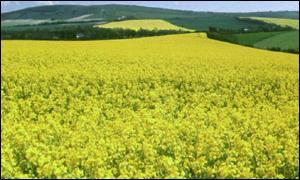
The slowest motion train wreck in history is the unfolding horror show of GM technology. (Disclaimer: I am not a Luddite, nor am I opposed to all "tampering with nature", nor am I an ill-informed granola-cruncher with knee-jerk oppostion to "evil GM". This is serious stuff here, and I am quite serious about it.) The reality of GM testing and its commercial deployment is so far from the cynically glib pronouncements of its deluded proponents that it leads one to begin to doubt literally every word they say. They mouth platitudes about careful testing and scientific consensus about safety, when they know that no such things exist or could even be faked up if required. The thing is, they probably won't be required. This is because the main community relations effort of the giant headless chicken corporations that produce the actual GM products consisted of a very effective pre-emptive smear of anyone who opposes GM technology for any reason. Now we have a scenario where they roll out GM rapeseed to a few willing UK farmers (surrounded by a small horde of vociferous protesters and a vast, worried but quiescent public) blandly assuring us that gene transfer to create "superweeds" is a billion-to-one improbability (note the scientific precision of that; they obviously did tests far too sophisticated for us to understand.) Within a mere three years there is the news of the discovery of a GM superweed that herbicides cannot kill. It rates a few anxious paragraphs and the world goes back to its nap. Meanwhile, in the jungles of South America, GM trees are the latest untested and almost unimagineable threat to the vital rainforest.
Margaret Beckett is accused of blocking the government from considering building new nuclear power plants as part of its strategy for achieving carbon emission reductions. On one side of the argument, some government policy wonks think solar and wind energy are "unproven" and too expensive, and say nuclear power has the "potential" to be green. But committed environmentalists will never buy that. How can a technology be called "green" if it produces deadly wastes? I myself would have to come down on the no-nukes-ever (what part of "no" don't they understand?) side of the argument.
A posting by Dr. Menlo in American Samizdat links to this article by David Owen, reprinted from the New Yorker magazine, called Green Manhattan. The article points up the paradox that the most environmentally-responsible living takes place in the very environments that are considered ecologically catastrophic - densely populated cities like New York. Where over 80% of workers commute either by public transit, on foot or by bicycle, a rate that is 10 times the US national average. Where those great destroyers of the environment, the lawn, the highway and the second car, are virtually non-existent. And where energy usage per household is a fraction of that in the suburbs and the idyllic countryside.
How to Save the World's Dave Pollard has a recent post about four under-reported stories in the media, and I was particularly taken by the last one. It concerns a battle for the board of the Sierra Club that is pitting a new influx of anti-immigration activists and radical animal-rights activists against the longer-term, mainstream environmentalists and their new ally. Morris Dees of the Southern Poverty Law Center.
Wampum, a blog focusing partly on American Indian issues, has a post about the effects of the California fires on Indian lands, homes and lives.
|
|