27 December 2006
Deborama's WWW Number 5 - Unfairpak
American readers of the blog will probably not be familiar with the Christmas hamper concept, unless they are even older than me and reside in the Northeast, perhaps. But the Christmas hamper has been the main vehicle of Christmas cheer for working class families in Great Britain since the early 20th century, and Farepak was one company leader in this field, a company which combined elements of direct sales, network marketing and modern finance with the old fashioned idea of "buying Christmas" a year ahead of time and paying for it in small zero-interest payments throughout the year. A charming picture until it all went horribly wrong in September of this year. This website, a real grass-roots effort by victims of the fund's collapse, tells the intricate but nauseatingly familiar story of big banks balancing their books on the backs of small consumers and workers.
23 December 2006
Another budgie done gone
Sadly, I must report the sudden death of Sanjay, our prettiest budgie. Last night, after a normal day of playing and chirping and other birdy activities, he suddenly fell off his perch and just died. So now there are four. They seem OK, so it must have just been his time to go. To budgie heaven.
Blogkeeping - New Blogger
I have taken up the new Blogger format with the possibility of categorising posts and numerous other options. I have begun the process of re-templating my "lesser" blogs, Deborama's Book Reviews and Store, Deborama's Kitchen and Deborama's Fund of Knowledge. If you ever read these blogs, please take a moment to look at the format and give me feedback. I have not added back in all the little bits, the javascripts and the sidebar links, but I will if the format seem to be working out OK. I have another blog which I have made private, which is just personal photos and various trivia. If you want access to that, send me an e-mail and request it. (You will have to get a Google account, but you won't have to use it for anything else if you are one of those anti-Google fanatics. Personally, I kinda like Google and all their stuff.)
20 December 2006
Deborama's WWW Number 4 - Subversive Cross-stitch

I am just barely under the wire here, and only if I count Alaska time and not GMT. Also, probably too late for Christmas gift shipping, but these might make a good New Year's present for the right kind of person: it's Subversive Cross-stitch. No need to explain what it is, it does exactly what it says on the tin, as the Brits would say. There is also a book .
.
. 18 December 2006
New Orleans writers struggle to pen rebirth story
Tonight and tomorrow night BBC Four TV will be showing Spike Lee's When the Levees Broke. Earlier I posted about a spate of excellent books that came out over the year and a bit since Katrina. One that I didn't know about then but later discovered was by one of my great favourite authors from New Orleans, Andrei Codrescu, New Orleans Mon Amour (actually a collection of stories, poems and essays spanning the last 20 years, from and about NOLA.) I bought the book for my daughter, another doomed lover of the Big Easy, and I have heard that she liked it a lot. And now I found this story, one of many concerning how the various communities of New Orleans, the musicians, the artists, the political activists, have been struggling creatively but often painfully, to rebuild in the wake of the great deluge.
(actually a collection of stories, poems and essays spanning the last 20 years, from and about NOLA.) I bought the book for my daughter, another doomed lover of the Big Easy, and I have heard that she liked it a lot. And now I found this story, one of many concerning how the various communities of New Orleans, the musicians, the artists, the political activists, have been struggling creatively but often painfully, to rebuild in the wake of the great deluge.
14 December 2006
Look, I know this isn't consistent, but . . .
This just makes me sick. Ok, I wasn't at the trial and I should not judge someone by the expression on their face and I am not one of these uber-feminists who believes all men are rapists or even that most men are. And yes, I have thought that the astonishingly high numbers of people who claim to have been molested by a relative, usually a father or grandfather, is a little questionable. But dammit - look at his face. And look at his words: "I have no idea why my daughter hates me so much as to falsely accuse me of raping her." Well, that's damned suspicious. It would be more believable if you could come up with a plausible reason. Lots of girls are angry when their fathers leave their mothers and it usually doesn't escalate to an accusation of rape, then a formal charge, then a dramatic and messy suicide. How likely is it that a 17 year old girl genius would jump out of a hotel window to certain ugly death just to score a point against her innocent but hated father? I just don't think so.
13 December 2006
Deborama's WWW Number 3 - Television Without Pity
My Wednesday Website of the Week for this week is Television Without Pity. This wacky website is couch-potato heaven, with the most in-depth, spoiler-ridden episode guides to current and past TV series you can hope to find. It includes the high-brow and the low, the silly and the sublime, although all the reviewers are rather silly. The episode synopses can run to 14 or more web pages and are often more entertaining than the show itself.
08 December 2006
Ali Rap
 A new book produced by graphic designer and long-time friend of Muhammad Ali, George Lois, Ali Rap, is a collection of "quotable moments" and iconic images of "The Greatest". Lois is also well-known for his infamous Esquire magazine cover of Ali as St. Sebastian (left). The history behind the picture is fascinating.
06 December 2006
Deborama's WWW Number 2 - 6 degrees of Wikipedia
The second ever Deborama's WWW (Wednesday Website of the Week) is Six degrees of Wikipedia. In case the name is not self-explanatory enough, it works like this. You type the titles of two Wikipedia-articled people, places, things or concepts into the two search boxes provided and click on "go". It returns the number of links that separate them. I was astonished how short the links are. I tested it first with my ex-brother-in-law (the only near relative I was sure would be Wikiable) and HM the Queen (entered as Elizabeth II). There were only four degrees of separation; in fact, only three if I did not exclude day-and-date pages. (Try it and you will see why: Wikipedia cross-references all the dates it cites on grand index pages by year, month and day.)
Postscript: SInce just after I posted this, I have not been able to access this site; I keep getting a server-down message. Apologies to readers who tried it and couldn't access.
Postscript: SInce just after I posted this, I have not been able to access this site; I keep getting a server-down message. Apologies to readers who tried it and couldn't access.
03 December 2006
I have to have this book!
NPR's books previews website, from which I get a daily feed, today has a book called Sister Bernadette's Barking Dog, which is a fond look at the lost art of diagramming sentences. An art that I deeply regret the loss of, by the way.
, which is a fond look at the lost art of diagramming sentences. An art that I deeply regret the loss of, by the way.
Enter Sandman
City Pages has a great article about and interview with Neil Gaiman. I love the headline : Why Neil Gaiman is about to become bigger than Death. If you're a Gaiman fan you will get that. But apparently our boy is not the nerdy comic book writer and story teller he once was (not that he was then, either, but he came off that way). There are a massive raft of movies coming out in the next few years that are either based on his novels or graphic novels or otherwise involve him in the production. One is a live-capture version of Beowulf and one is called Death and is based on the Sandman graphic novels. I am sort of a Neil Gaiman fan. I still have never read Good Omens, which he co-wrote with Terry Pratchett and a few of his books I was not able to get into. On the other hand, I did love the Sandman series and also his novel American Gods.
. I am sort of a Neil Gaiman fan. I still have never read Good Omens, which he co-wrote with Terry Pratchett and a few of his books I was not able to get into. On the other hand, I did love the Sandman series and also his novel American Gods.
01 December 2006
The Freakonomics guy is blown away by Barack Obama
If Barack Obama is as good a politician as he is a writer, he will soon be President, says Steven D. Levitt of Freakonomics fame. The many pages of comments hash out the question of whether or not he (Obama) is in fact a good politician, and with the lively participation of conservatives, it's about even.
29 November 2006
Deborama's WWW Number 1 - McSweeney's
The very first one - a subsite of McSweeney's, a very unusually structured blog / wiki thing. This site is dedicated to interviews with people who think their jobs (in some cases previous jobs) are unusual or interesting. The one I read first, and still like best, is the one about working at a strip club with your Mom.
New feature - Deborama's WWW
I am instituting a new feature on Deborama starting today: it is called Deborama's WWW (Wednesday Website of the Week). This is partly inspired by the BBC Radio 2 feature "Miles Mendoza's Website of the Day", which, although I enjoy it, I have often thought I could do better.
If I get really energetic at this, I may post them more often than weekly, in which case they will be titled "Deborama's WMD" (Website More-or-less Daily).
If I get really energetic at this, I may post them more often than weekly, in which case they will be titled "Deborama's WMD" (Website More-or-less Daily).
27 November 2006
The timetable for withdrawal from Iraq

According to the inimitable Steve Bell. In another bygone era (the early 1970s) there was a joke about something that was not very funny. "What do you call 7500 GIs and 10000 US Marines dangling from the runner of a military helicopter?" "An orderly withdrawal from Southeast Asia." (Alternative answer : peace with honor. Honor. What a quaint word.) The same so-called joke can soon be applied to Iraq, but you might want to add "over the smoking wreckage of an overloaded British helicopter?" And they had the gall to say Iraq was no Vietnam.
The lost boys of Japan
On NPR's All Things Considered, Michele Norris talks with Michael Zielenziger, author of Shutting Out the Sun: How Japan Created Its Own Lost Generation.
Zielenziger profiles a caste of Japanese youth called hikikomori, mostly young men who lock themselves away in their bedrooms, fearful of society's expectations. He also talks about Japan's aging working class and the tendency of young women to shun motherhood.
Hurricanes may hardly ever happen . . .
. . . in Hampshire, according to Professor 'iggins. But what about tornadoes?
22 November 2006
Farewell to a cinematic genius
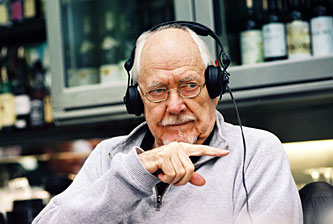
It's another month, another Deborama obituary. Maybe this is what it means to be over 50. But Altman, who passed away yesterday, was one year older than my Dad (and the Queen.) McCabe and Mrs. Miller has remained on my top-20 list of films for over 30 years.
20 November 2006
Now, she just wants to get them home . . .
I found this heart-rending NYT article about 30-year old Capt. Stephanie Bagley through Google News. It's just one of many on-the-ground reports from Iraq that paint a picture of despair and lost faith. In 2003 this blog and many journalists, historians and military experts speculated over whether Iraq would become GWB's "Vietnam". I don't believe things were ever this bad in Vietnam, not just from a specific body-count perspective (where Vietnam was much worse), but in terms of how quickly it all went wrong and how bad we will leave things when we leave. And certainly from the perspective of the morale of the soldiers, Iraq is the worst. With Vietnam, the leaders tended to question the motives behind the war after they got back home, if at all. But just to imagine a young person, in a position of command, with life-or-death responsibilities, who can find no way to believe in their mission but is impelled by duty to do it, it makes me weep. There has been a lot to make me weep in this terrible misadventure.
Catch-up

I have thought, more than once, that the Catholic church could use blogging software as a vehicle for confessions. There would be no need for the "it has been nine days since my last confession" declaration, because the posting dates are very good guilt-tripping devices. (But you can tell I'm not really a Catholic - for one thing I think individual confession is now obsolete, along with limbo and St. Christopher.)
There's too much going on on the personal level for me these days. It's not that there are not plenty of outrages and other noteworthy things going on in the news, it's just that it has to be really extreme before I think my contribution is needed. (And of course, it's never needed, that's just hubris speaking.) I visit MySpace every day, but not my blog. In fact I have met (not in person yet, but soon I hope) a fellow female American ex-pat who lives in a village not 5 miles from here. She is also something of an expert on pet birds, and has a flock of them herself. I finally got the device hooked up to my "newer" laptop, the one that fried, so the little memory stick port no longer works :( , so that I can upload pictures from my camera and I have put here the best of many pictures of our five budgies. Their names, in order left to right, bottom to top: Huey, Pearl, Holly, Sanjay and Hilary.
08 November 2006
Bernie Sanders - first socialist in the US Senate
They say the Senate still "hangs in the balance" due partly to the wins by two independents. But one of those is Vermont's new junior Senator Bernie Sanders, formerly its only Representative, and before that the long-time mayor of Burlington. I think we can safely assume he will vote with the Democrats a lot of the time, though.
Amy Klobuchar Wins MN Senate Seat - first woman Senator from Minnesota

Klobuchar takes over the Senate seat vacated by liberal Democrat Mark Dayton. Part of the whole balance tipping deal.
And Keith Ellison, First Muslim Elected to Congress
Like it says. And even better, he's my Congressional rep. Cool.
That's Keith in the picture up there, next to Amy.
That's Keith in the picture up there, next to Amy.
Hola, Daniel (y Rosario)
Hasta La Vista, Baby to Donald. I find it a delicious irony that ex-Commandante Daniel Ortega, with wife Rosario Murillo as the power behind the throne, wins the presidential election in Nicaragua and the next day his old nemesis Donald Rumsfeld is forced to resign in disgrace. Nicaragua is desperately poor, with most of the population in extreme poverty. And this is all down to Rummy and his Cold Warrior chums crushing the life out of the country with years of low-level warfare and economic blockade after the Sandinistas first came to power.
There are a lot of little ironies in Nicaragua's political scene. Like Ortega's running mate, who is an ex-Contra and whose house was commandeered by Ortega years ago. (As a gesture of reconciliation, however, Ortega has since paid him compensation, but he kept the house.) Other excellent news from the US elections. Democrats now control the House. Other details to follow . . .
There are a lot of little ironies in Nicaragua's political scene. Like Ortega's running mate, who is an ex-Contra and whose house was commandeered by Ortega years ago. (As a gesture of reconciliation, however, Ortega has since paid him compensation, but he kept the house.) Other excellent news from the US elections. Democrats now control the House. Other details to follow . . .
01 November 2006
Wolfman meets Dracula and the dangers of zombie sex
Just a little too late for Hallowe'en, I found this priceless article in City Pages, a sort of agony aunt for those in real agony - contemplating carnal relations with various species of the undead for example.
On the way home from work, we tend to listen to a particularly mindless radio show on BBC Radio 1. Today the DJ or host or whatever he is, Scott Mills, tried lamely to stir up a controversy that people, especially in Britain and especially "these days", don't "appreciate the true meaning of Hallowe'en". According to Mills, the true meaning of the holiday has something to do with devil worship, and therefore if you are going to dress up, it should be as a witch, warlock or Satan. What rubbish! This man knows absolutely nothing of his heritage, particularly given the fact that he is gay. The "Hallow" in Hallowe'en is hallowed as in holy or in this instance, saints. What has that to do with devil worship. And what has devil worship to do with witches and warlocks? And anyway, the minor Christian (not Satanic) holiday of Hallowe'en has been combined with the forbidden Celtic pagan one called Samhain. This is traditionally a time when the boundary between the mundane world and the world of faerie thins and vanishes. It is in the folk memory of the "the faerie court will ride" that people indulge in fancy dress and wild parties. To my mind, that is the true meaning of Hallowe'en.
On the way home from work, we tend to listen to a particularly mindless radio show on BBC Radio 1. Today the DJ or host or whatever he is, Scott Mills, tried lamely to stir up a controversy that people, especially in Britain and especially "these days", don't "appreciate the true meaning of Hallowe'en". According to Mills, the true meaning of the holiday has something to do with devil worship, and therefore if you are going to dress up, it should be as a witch, warlock or Satan. What rubbish! This man knows absolutely nothing of his heritage, particularly given the fact that he is gay. The "Hallow" in Hallowe'en is hallowed as in holy or in this instance, saints. What has that to do with devil worship. And what has devil worship to do with witches and warlocks? And anyway, the minor Christian (not Satanic) holiday of Hallowe'en has been combined with the forbidden Celtic pagan one called Samhain. This is traditionally a time when the boundary between the mundane world and the world of faerie thins and vanishes. It is in the folk memory of the "the faerie court will ride" that people indulge in fancy dress and wild parties. To my mind, that is the true meaning of Hallowe'en.
25 October 2006
What it's come to
I am sort of watching (intermittently listening to) PMQs on the TV (Prime Minister's Questions for those not familiar with British politics, and no, I can't explain what it is, you will just have to watch it sometime.) I see in the Guardian that support for Labour has slipped to a 20-year low, and that the Conservatives have a chance at coming back to power. How can they be so stupid? Also in the Guardian is this excellent comment piece from Simon Jenkins on Iraq.
This country has been turned by two of the most powerful and civilised nations on Earth into the most hellish place on Earth. Armies claiming to bring democracy and prosperity have brought bloodshed and a misery worse than under the most ruthless modern dictator. This must be the stupidest paradox in modern history. Neither America nor Britain has the guts to rule Iraq properly, yet they lack the guts to leave.
Blair speaks of staying until the job is finished. What job? The only job he can mean is his own.
I voted
Two years ago, I joined Democrats Abroad, not that I'm a Democrat necessarily (except, of course, the small "d" kind) but it was important to try to oust Bush when we had the chance. Now "we" (whoever that is) have a chance to have a Democratic congress. Not that that is going to solve all the world's ills, but at least they will (hopefully) stand up to Bush and give him a cold bath of reality for his last two years in office. But anyway, I managed to get myself just barely organised enough to do the ballot and get to a post office and get it sent on its way.
Not much else going on in my so-called life. Today we are getting two more budgies - numbers four and five - who are hand-reared babies. I have managed to get myself back to Pilates for two weeks in a row. I think our GPs are going to get all medieval on my husband and me and force us to tackle our obesity (that awkward phrasing is somewhat appropriate, because it is rather as if we share one big obesity between us.) More on the subject of health - we joined an organic box scheme, and I have blogged about it over at Deborama's Kitchen. (I apologise for the wonky layout of DK; I am working on it.)
And this Saturday I am planning to go to London with friend and fellow American ex-pat Jay. The main objective - a trip to Harrod's (we've never been, either of us.) I probably won't buy anything more than a book and what my DH calls "foodie shites". It's more for the experience.
Not much else going on in my so-called life. Today we are getting two more budgies - numbers four and five - who are hand-reared babies. I have managed to get myself back to Pilates for two weeks in a row. I think our GPs are going to get all medieval on my husband and me and force us to tackle our obesity (that awkward phrasing is somewhat appropriate, because it is rather as if we share one big obesity between us.) More on the subject of health - we joined an organic box scheme, and I have blogged about it over at Deborama's Kitchen. (I apologise for the wonky layout of DK; I am working on it.)
And this Saturday I am planning to go to London with friend and fellow American ex-pat Jay. The main objective - a trip to Harrod's (we've never been, either of us.) I probably won't buy anything more than a book and what my DH calls "foodie shites". It's more for the experience.
14 October 2006
Muhammad Yunus, Nobel Peace laureate 2006
As Muhammad Yunus, founder of the Grameen Bank, "the most effective anti-poverty organisation in the world" is announced as winner of the 2006 Nobel Peace prize, Middle Tennessee State University is proud to claim him as one of their own. (He was a professor of Economics there.) Back in Tennessee, Yunus's work with the Grameen Bank has always been greatly admired - and influential. Numerous economics students from Tennessee have served internships with Grameen Bank in India, and some southern progressives are considering a programme based on it to help the refugees of Hurrican Katrina.
We are now just another tribe
A quote from a British officer serving in Basra. Here is the whole quote, and its context:
Basra has become riddled with organised gangs, militias and death squads, and its police force is corrupt. According to senior coalition advisers, there are around 20 different security and police groups in the city, ranging from the directorate of education police to the justice police; the governor alone has 200 armed gunmen protecting him. Some of the police units are active in organised crime and have been infiltrated by militias, others work as death squads. There are also around a dozen religious militias.
"We are in a tribal society in Basra and we [the British army] are in effect one of these tribes," said Lt Col Simon Brown, commander of the 2nd Battalion. "As long as we are here the others will attack us because we are the most influential tribe. We cramp their style."
29 September 2006
"Evidence of the ball" convicts controversial umpire
I doubt that there is anyone in the world for whom Deborama is their main source of cricket news. Nevertheless, for my own sense of closure, I will post a link to this arcane (to me) and masterful commentary on the latest, and nearly last development in the Hair vs. Inzamam saga over ball-tampering allegations and a forfeited test match. To summarise, the ICC (International Cricket Council) has ruled on the charges, and Inzamam, captain of the Pakistani team, is cleared of ball tampering, but convicted of "bringing the game into disrepute" due to the Pakistani team's sit-in protest over the cheating allegation. But the fact that the key charge that started it all, that some unspecified member of the Pakistani team tampered with the ball, has been overturned by the ICC is almost unprecedented, possibly a career-ender for the controversial umpire Hair, and bad news for umpires generally. Angus Fraser, author of the linked article, had a chance to examine the ball himself, and agrees that there is nothing like conclusive evidence of tampering, even if such a thing could be concluded from the appearance of the ball alone. Another expert witness examined the ball briefly then tossed it aside with a curt "There's nowt wrong w' that." So, ahem. Fraser reckons laws are due to be changed in the near future.
28 September 2006
Bereft of a budgie
Sadly, one of our budgies flew the coop on just the third day of his stay with us. Earl, the one lurking in the background in the picture below, shot out of the cage and out an open transom and we have not seen him since. But this was just after what was meant to be the fourth budgie was introduced to the cage. He is Huey, a yellow-green with grey factor (I think). Apart from that, the budgies are fine. I got Sanjay to come right up close to my hand, holding a millet spray, inside the cage. Pearl is quite wary of me, though, and the new guy, Huey, is somewhat subdued. His head is so fluffy it is hard to tell when his eyes are open. A lot of my Google activity the last few days, apart from trying to find a sports bra to replace the one that's missing, has to do with budgie behaviour and care. I will post more pics soon. The news from the outside world has mostly been too dreadful to comment on.
24 September 2006
Our three new arrivals

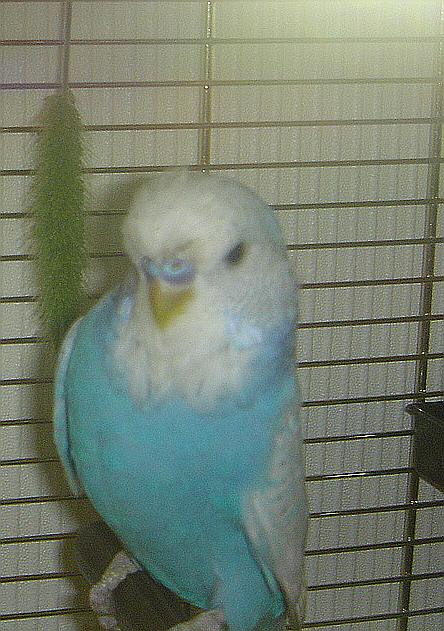
The size of our family has just doubled this weekend. Previously, it was me, DH and Des (a dog) and yesterday we added Sanjay, Pearl and Earl, three lovely budgerigars. They have already settled in, although we are going to get them a nicer and bigger cage very soon, and today we went out and bought lots of cute little bird toys for them. This is a new experience for me, although DH had pet birds in his childhood.
23 September 2006
100 Years Ago in Atlanta

NPR has this story about the Atlanta race riot of September 22, 1906. At the time, it was a world-wide story, reported as far away as Italy and France. (The picture left is of a contemporary French newspaper.) In its immediate aftermath, black and white leaders of Atlanta began meeting, the most virulently racist and sensationalist newspaper went out of business. Within 10 years, the movement for black equal rights had turned its back on the accommodationist philosophy of Booker T. Washington and turned to a more activist agenda. However, the race riot has not been taught as part of the history curriculum of Atlanta or Georgia or the US. Until this year, that is, when Georgia politicians re-discovered the lesson and its importance.
18 September 2006
The truth about fundamentalism
Karen Armstrong is the foremost world authority on the fundamentalist elements of all three "religions of the book". I am amazed that she can maintain her academic detachment, knowing all she knows about the bloody histories of their fratricidal contention. Today's comment in the Guardian gives just a taste of what she's on about.
What's wrong with Kansas/Connecticut/the Democrats?
Gary Younge is so brilliant. Here is another wonderful commentary he's written in the Guardian, which has the best explanation about how electoral politics work in the US (without getting into the whole "third" party miasma - don't get me started!) This will explain, far better than I ever could, why people who are too poor to pay taxes love the Republicans, why the numbers don't seem to add up in the red state/blue state comparison (hint: they are ignoring someone - could it be? oh, no not again! - black people!!) and, most perplexingly to Brits who know a few Americans, how someone like GW can be elected and even popular.
Some provocative excerpts:
Some provocative excerpts:
In his book What's The Matter With Kansas?, Thomas Frank described the tendency of working-class people to vote Republican as a form of derangement. He said that the working class had been hoodwinked into voting against its economic interests by "values" issues such as abortion and gay rights. There were two main problems with this argument. . .
So what's the matter with all these analyses? First of all they seem to step over a huge elephant in the room - namely race. There is a reason why we are only talking about white working-class voters: black people, regardless of income, overwhelmingly vote Democrat. Indeed, were it not for black people, the Democrats would have won the presidency only once, in 1964. That was the year President Lyndon Johnson signed the civil rights act, turned to an aide and said: "We have lost the south for a generation." We are well into the second generation now, and the racialised politics of the south seem to be influencing the rest of the country rather than the other way round.
12 September 2006
My second hotspot blog
Well, not counting the two I did in between from a motel in Minneapolis. I am back in Keflavik in the 1.5 hour stopover between Minneapolis and London Heathrow.
The trip was great. The highlight, after being there for my grand-daughter's 3rd birthday celebration at a faux Italian kid-friendly restaurant, was Homecoming Sunday at Walker Church. The music has got better in the three years I have been away. It was very powerful. I requested number 62 in the Walker songbook - a countryish number called Powerlines by a guy called Larry Lattanzi.
Powerlines across the prairie
Haybales in the rain
Fields that stretch forever
Fenceposts across the plain.
It's a song about riding the train through America's heartland on a "steel gray afternoon" and just the ticket for the homesick blues. We finished up with "I saw the light" and then of course "Amazing Grace" in the circle afterwards. I feel better now.
The trip was great. The highlight, after being there for my grand-daughter's 3rd birthday celebration at a faux Italian kid-friendly restaurant, was Homecoming Sunday at Walker Church. The music has got better in the three years I have been away. It was very powerful. I requested number 62 in the Walker songbook - a countryish number called Powerlines by a guy called Larry Lattanzi.
Powerlines across the prairie
Haybales in the rain
Fields that stretch forever
Fenceposts across the plain.
It's a song about riding the train through America's heartland on a "steel gray afternoon" and just the ticket for the homesick blues. We finished up with "I saw the light" and then of course "Amazing Grace" in the circle afterwards. I feel better now.
09 September 2006
Wasn't that a time?
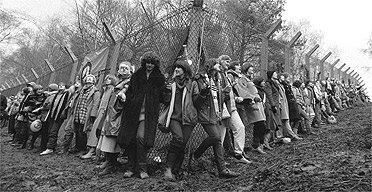
The Guardian has a retrospective article about the Greenham Common Peace Camp. Participants in the demonstrations are asked for their recollections, both the positive and the negative, and it is interesting to see where they are now and how they compare the political feel of the present day to 1981-83. One of the women pictured left is now a Plaid Cymru member of the Welsh Assembly. She feels very betrayed by the Labour party's present support for war in Iraq and the Trident missile. No surprise there. Many women today question the exclusion of men that was a major hallmark of the Greenham Common camp. Could there be a connection, do you think? Who knows how many gentle, thoughtful young men, now more anonymous even than the Greenham heroines, were discouraged forever from political activism, and what if they had come to lead the Labour party, rather than a naked opportunist named Blair and a curiously old-school, paternalistic socialist named Brown, and all their male and female acolytes, none of whom would have been at Greenham Common in the first place? It kind of makes you think.
03 September 2006
Minneapolis
I have been in Minneapolis since the evening of the 29th and I've been pretty busy catching up with my grand-daughter Savannah and my daughter Aimee. On Wednesday we went to the Midtown Global Market, which is almost as good as I had been led to believe. My middle sister Cindy was also here from Wednesday night through Saturday morning. We took her to the Seward Cafe Thursday morning and on Friday she took Aimee and Savannah on a mini-shopping-spree at the Mall of America. We all got together with Savannah's paternal grandma and her sisters and mother on Friday night at the Old Spaghetti Factory for Savannah's 3rd birthday. Savannah is a big fan of Dora the Explorer and her cake and most of her presents featured Dora and her companions. Aimee and Savannah go home tomorrow night and then I must turn my attention to all my friends here that I came here to see. The trip will culminate for me with Homecoming Sunday at Walker Church and then back home via Reykjavik. I really have no excuse not to blog constantly, because there is free wifi everywhere including my motel. But as you can see, I am not blogging constantly; must be age and laziness.
29 August 2006
My first hotspot blog
This is my first ever blog from a hotspot. And what a cool hotspot. I am in the cafe in the Reykjavik airport, in transit from London HR to Minneapolis. The future has truly arrived for me. I envisioned something like this when I was a 12 year old just discovering science fiction. No really, I did. Not exactly like this, of course. But not dissimilar.
23 August 2006
More generalisations on race, nationality and otherness - the umpire strikes back
So, a little English boy comes home from school after his first introduction to cricket. Mum says "What did you learn today?" (as you do) and the lad replies, "I learned all about cricket. They throw balls at you and if you don't hit them, you're out. Unless the ball hits you in the leg, and then you're a BMW." (For non-cricket-playing folk, see Law 36 for an explanation. Not that you'll understand it any better.)
I have been following the story of the forfeited test cricket match, with all its overtones of dying empire, the tough but fair Aussie umpire, the aggrieved and dignified Pakistani team captain, and the British, Asian and Australian public, all divided in opinions and slants on the subject. (Except for those who don't really care.)
Sport is a tricky subject, but cricket is especially so. A lot of people see it as a pretentious, upper-class holdover, and it does embody a lot of the worst and best about Englishness. And then it is transmuted through the crucible of colonialism, so that there is a quintessentially West Indian cricket, a brusque and ultra-conservative Australian cricket and a passionate version of Pakistani cricket, charged with politics and nationalism. It never really caught on in anglophone Canada (not that I noticed) let alone Scotland, Wales or Ireland, yet India, Sri Lanka and South Africa all have their devoted fans. What is it about cricket - is it the tea interval, the silly white coats and stilted gestures of the umpires, the massive and Byzantine "laws of cricket" (when other sports, even English ones, are quite happy to have "rules".) And is this latest crisis, which some have called a farce, the echo of a dying empire or the roar of an unrepentant umpire?
I have been following the story of the forfeited test cricket match, with all its overtones of dying empire, the tough but fair Aussie umpire, the aggrieved and dignified Pakistani team captain, and the British, Asian and Australian public, all divided in opinions and slants on the subject. (Except for those who don't really care.)
Sport is a tricky subject, but cricket is especially so. A lot of people see it as a pretentious, upper-class holdover, and it does embody a lot of the worst and best about Englishness. And then it is transmuted through the crucible of colonialism, so that there is a quintessentially West Indian cricket, a brusque and ultra-conservative Australian cricket and a passionate version of Pakistani cricket, charged with politics and nationalism. It never really caught on in anglophone Canada (not that I noticed) let alone Scotland, Wales or Ireland, yet India, Sri Lanka and South Africa all have their devoted fans. What is it about cricket - is it the tea interval, the silly white coats and stilted gestures of the umpires, the massive and Byzantine "laws of cricket" (when other sports, even English ones, are quite happy to have "rules".) And is this latest crisis, which some have called a farce, the echo of a dying empire or the roar of an unrepentant umpire?
20 August 2006
Doonesbury today

Today's Doonesbury is one of those that will stand out as a classic, in my opinion. I found it powerful and affecting.
While we're on the subject, here is a good charity to help the innocent victims in Lebanon, if you're so inclined.
Blog's been quiet, I know. I am trying to get into a new exercise routine, but also saving my energy for the great leap across the pond to occur Tuesday, 29 August.
11 August 2006
Murray Bookchin

I forgot to post an obituary link for the wonderful Murray Bookchin, who died four days ago. This seems to be a big year for the passing of venerable old leftists, but Murray was a peach, way ahead of his time and his generation. He was thinking in terms of a red-green coalition and libertarian socialism before there were even the words of a common language to express such ideas. Fortunately, he was also a good wordsmith and so could make them up.
09 August 2006
Electoral fantasies
I neglected to post at the time, but a week or so ago, More4 (TV channel) in the UK broadcast the last two episodes of The West Wing, bracketed by a half hour mock quiz show (a thing the Brits do so well) (shown twice, that's how it bracketed) on all things West Wingish. If you think that sounds really stupid, one of the contestants was David Tennant, lately of Dr. Who triumph, and another was Mark Oaten, recently (supposedly) disgraced MP in the Lib Dem party, behaving not the slightest bit disgraced, thank you very much. The quiz show was all charming; yet a third contestant was Arabella Weir, a lady with a very sophisticated sense of irony.
Contemporaneously with the progress of the West Wing was the birth and growth of the political blog. Blogs made an appearance on TWW, first as a joke, then as an irritant to the WH press office, then as a serious, if novice, player at the tables of political power negotiation. (This story arc roughly paralleled their actual place in the American political landscape at the relevant times.)
Now, in the realm of what used to be only a liberal pipe dream, a right-wing Democratic Senatorial sinecure has been toppled, largely by the power of liberal bloggers and their close allies, web-based activist groups such as MoveOn.org.
Contemporaneously with the progress of the West Wing was the birth and growth of the political blog. Blogs made an appearance on TWW, first as a joke, then as an irritant to the WH press office, then as a serious, if novice, player at the tables of political power negotiation. (This story arc roughly paralleled their actual place in the American political landscape at the relevant times.)
Now, in the realm of what used to be only a liberal pipe dream, a right-wing Democratic Senatorial sinecure has been toppled, largely by the power of liberal bloggers and their close allies, web-based activist groups such as MoveOn.org.
03 August 2006
Not Nice People, part I
"It's the stupidity, stupid." So says Mathew Yglesias, long one of my favourite political bloggers (now with Prospect magazine) and probably a fairly nice person, although I don't know him apart from his writing. Which is quite intelligent. The Stupid One? Oh, that's George W. Bush, of course. So profoundly not a nice person that words utterly fail me. I cannot write blogs about what a bad person the current "leader of the free world" is, but fortunately I don't have to. There are many others who do, and I admire, salute and quote them.
Not Nice People, part II
Christopher Hitchens (not all that nice a person himself) is especially vitriolic in his condemnation of Mel Gibson. "Sick to his empty core with Jew-hatred" is in fact how he describes the unfortunate Mr. Gibson, now described in Hoolywood lingo as "toxic". Well, not much wiggle-room in that expression.
Why It Is Called Bath
The city of Bath, not surprisingly, started out as a settlement around a Roman bath which in turn was there because of a natural hot mineral spring. The thermal spa survived for 1200 years until 1979, when it was closed due to a death from Legionnaire's disease. Today it finally re-opens. The new spa has been decades in the planning and a few years in the building. It was a millenium grant that finally got the ball rolling, and still there were problems, including an abortive attempt to open last year. As the BBC says, the city has its soul back.
02 August 2006
When worlds collide
I really wanted to post the accompanying picture to this brief article in the Independent, but it was not on the web, apparently. The story is about a boatload of refugees from Africa who landed on a pleasure beach in the Canary Islands, and the picture, a two page spread of stunning impact, showed the dehydrated asylum-seekers, some of them barely conscious with heat exhaustion, being administered water, shade and human comfort by holiday-makers as they all awaited the arrival of a Red Cross rescue team.
In less heartening immigration news (not about immigration at all, in fact, which is what makes it especially maddening), the same paper had the story of numerous cases of respected musicians who have been deported from or refused entry to the UK due to visa technicalities. Care to take a guess which continent most of them happen to hail from? Included in the litany of ignominy is the story of Thomas Mapfumo, billed for the Womad Festival but sent back from the airport to Zimbabwe, and a nine-member Mozambique group not permitted to pass through Britain on the way to a concert in Italy because of the lack of transit visas. I really cannot say anything more about all this, or I will start ranting.
In less heartening immigration news (not about immigration at all, in fact, which is what makes it especially maddening), the same paper had the story of numerous cases of respected musicians who have been deported from or refused entry to the UK due to visa technicalities. Care to take a guess which continent most of them happen to hail from? Included in the litany of ignominy is the story of Thomas Mapfumo, billed for the Womad Festival but sent back from the airport to Zimbabwe, and a nine-member Mozambique group not permitted to pass through Britain on the way to a concert in Italy because of the lack of transit visas. I really cannot say anything more about all this, or I will start ranting.
24 July 2006
Flaming July
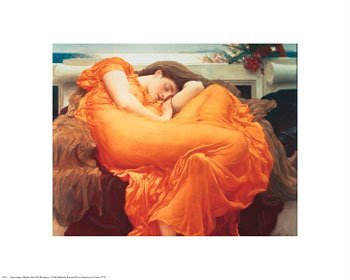
I am in full-blown rage-at-the-news mode this month. It is all so appalling, or else it's just squalid and depressing, or else it's the sort of thing that would be funny if it were not disgusting. Amongst the things exercising my rant-cells:
- The war between Israel and Lebanon/Syria/Hizbollah/Iran
- The uneven reporting between Israeli and Lebanese civilian casualties
- What all this is revealing about the US-UK relationship
- What the infamous "open mic" exchange revealed about the US-UK relationship
- Racially motivated murders
- UK plans for a "border" patrol NB: The UK is an ISLAND nation, and islands DO NOT HAVE BORDERS! Next time you rip off a failed policy from the US, at least adjust the language of it appropriately.)
18 July 2006
After the deluge
Here is a plethora of books on Hurricane Katrina,reviewed by NPR's All Things Considered. The links below are for possible purchasers in the UK and Europe. In the US, follow the links in the article to purchase and benefit NPR:
And one that NPR missed:
- Do You Know What It Means to Miss New Orleans? by Toni McGee Causey, Colleen Mondor, Jason Berry
- The Storm
- The Great Deluge
- Breach of Faith
- Path of Destruction by John McQuaid, Mark Schleifstein
- Dispatches from the Edge by Anderson Cooper
- 1 Dead in Attic by Chris Rose, Charlie Varley (Photographer)
And one that NPR missed:
- Come Hell or High Water
14 July 2006
Generalisations on race, nationality and otherness : Part I – British v. French
My DH and I have been engaged in a slow-burning debate since we first met over which national character is the more inherently racist, American or British. There is no acrimony or personalisation involved in this, it’s just an intellectual exercise to us, giving me (I can’t speak for him) a chance to show off my knowledge of history and powers of acute observation of human behaviour. (Of course, both of us being white, we can afford to be detached about it.) But I tell this to lead up to my statement that to me, the worldview of the typical white Briton is so overwhelmingly and obviously racist that I constantly marvel at how blind they all are to it. But that fits in with their general arrogance and blinkered self-interest in general, a fact that DH often marshals in his defence of his countrymen as maybe bastards, but not racist bastards.
For the last year or so, without any output or resolution, I have had these thoughts on national identity and “otherness” (which I am going to use without quotes as a more meaningful term for what is usually packed uncomfortably into the term ”racism”). The thought trail is so long and tangled that, like my thoughts a few years ago on the death of Christendom, it will take several quite long posts to get it all down. Even though the intro brought up the question of otherness in America, I will probably leave that to last, because, like America’s national identity itself, it is built up on that of its myriad predecessor nations. Instead I will start with the nation where I now find myself, which is either Britain or England, depending on who you ask, what language you use, the context, the season and probably the phase of the moon. (And thereby hangs a tale indeed). And I will discuss British national identity and its brand of otherness by comparing and contrasting with the French, the predecessor nation of England in many senses.
In a way, the impetus to begin this work was the absorbing story of Zinedine Zidane and what happened to him in the World Cup 2006 final game, final minutes. I won’t repeat the story; if you don’t know it and yet are still reading my blog, well, just follow the link and get caught up, OK? After England went out, folks at work naturally began to talk about the rest of the World Cup, whether they still cared, and who they would support and why. I said I would support France, because, well, I just like them. My next-desk neighbour, who was probably baiting me to some extent, asked about the well-known female predilection for supporting football sides based on the attractiveness of the players and I said I thought France excelled in that area too (neatly sidestepping, or so I thought, the personal nature of the question.) But, no, now he wanted to know which players in particular I thought this applied to. Henry, I replied, without hesitation, and Zidane. “Oh, so what you’re saying is you like black men.” Reader, I was speechless. I can just about imagine the most unregenerate redneck in Georgia (whom I personally happened to know back in the 70s) saying such a thing to me.
British people are always surprising me like that. Their arrogant assumption of superiority, for which they have no basis in evidence whatever, goes almost beyond mere arrogance into a realm of psychopathology. A fictional character who really illustrates this very well is that of Ronald Merrick in Paul Scott’s Raj Quartet. Although there are plenty of instances of the British treating African and Carribean people with brutality and contempt, the closest equvalent relationship to that of the one between white and black Americans is the strange co-dependency of the white Briton and the Indian, especially those of darker skin. I observe this every day and to American eyes, trying to decode it, it is baffling. The IT division where I work has many employees and contractors from the subcontinent and they are socially invisible to a great extent. With a few exceptions, a modern free-spirited woman who was probably second-generation and very assimilated, or a very light-skinned long-time passport holder with quite advanced skills who really, really tries to fit in socially, the Indian employees are only spoken to in a work context and are casually overlooked in a lot of informal social activity. Institutionally, I cannot help but notice that the corporate intranet has said not one word about the Mumbai bombings, as opposed to their strong reactions to 9/11 and 7/7, special collections, two minute silences, reports on our friends at the scene, despite the fact that we have far more colleagues either in or from Mumbai than either New York or London. But the thing that really surprises me is how Indians from India, as opposed to those born here, no matter how educated or Anglophile they are, completely acquiesce in their inferior treatment. DH says they are just naturally “like that”. Well, I rest my case.
It isn’t just India. Britain views her former empire as simultaneously still somehow hers and “nothing to do with me”, depending on the most expedient view for the case. If you try to pin them down on the unequal state of current relationships with immigrants from former colonies, or with a dysfunctional, exploitative relationship between governments of the same, they just sort of don’t understand the question, always a sure sign of a deep-seated superiority complex.
The French, on the other hand, just make me crazy. Looking at history, the coming together and breaking up of France’s overseas empire was more brutal and painful than that of Britain, especially after adjusting for relative length and size. But the thing is, that in trying to foil the independence of Indochine or Algeria, the French treated their colonies as enemies in a rebellion, not as recalcitrant children who must be whipped into obedience for their own good. The arrogance of the French was saying, why don’t all Africans and Asians just want to be part of France, as we want them to be? The arrogance of the British was saying, these dusky peoples will never be English (no more than the Scots and Welsh and Irish) but they should be grateful that we bother to rule them.
The following long quote illustrates, if nothing else, that I am not the only one to see it this way:
For the last year or so, without any output or resolution, I have had these thoughts on national identity and “otherness” (which I am going to use without quotes as a more meaningful term for what is usually packed uncomfortably into the term ”racism”). The thought trail is so long and tangled that, like my thoughts a few years ago on the death of Christendom, it will take several quite long posts to get it all down. Even though the intro brought up the question of otherness in America, I will probably leave that to last, because, like America’s national identity itself, it is built up on that of its myriad predecessor nations. Instead I will start with the nation where I now find myself, which is either Britain or England, depending on who you ask, what language you use, the context, the season and probably the phase of the moon. (And thereby hangs a tale indeed). And I will discuss British national identity and its brand of otherness by comparing and contrasting with the French, the predecessor nation of England in many senses.
In a way, the impetus to begin this work was the absorbing story of Zinedine Zidane and what happened to him in the World Cup 2006 final game, final minutes. I won’t repeat the story; if you don’t know it and yet are still reading my blog, well, just follow the link and get caught up, OK? After England went out, folks at work naturally began to talk about the rest of the World Cup, whether they still cared, and who they would support and why. I said I would support France, because, well, I just like them. My next-desk neighbour, who was probably baiting me to some extent, asked about the well-known female predilection for supporting football sides based on the attractiveness of the players and I said I thought France excelled in that area too (neatly sidestepping, or so I thought, the personal nature of the question.) But, no, now he wanted to know which players in particular I thought this applied to. Henry, I replied, without hesitation, and Zidane. “Oh, so what you’re saying is you like black men.” Reader, I was speechless. I can just about imagine the most unregenerate redneck in Georgia (whom I personally happened to know back in the 70s) saying such a thing to me.
British people are always surprising me like that. Their arrogant assumption of superiority, for which they have no basis in evidence whatever, goes almost beyond mere arrogance into a realm of psychopathology. A fictional character who really illustrates this very well is that of Ronald Merrick in Paul Scott’s Raj Quartet. Although there are plenty of instances of the British treating African and Carribean people with brutality and contempt, the closest equvalent relationship to that of the one between white and black Americans is the strange co-dependency of the white Briton and the Indian, especially those of darker skin. I observe this every day and to American eyes, trying to decode it, it is baffling. The IT division where I work has many employees and contractors from the subcontinent and they are socially invisible to a great extent. With a few exceptions, a modern free-spirited woman who was probably second-generation and very assimilated, or a very light-skinned long-time passport holder with quite advanced skills who really, really tries to fit in socially, the Indian employees are only spoken to in a work context and are casually overlooked in a lot of informal social activity. Institutionally, I cannot help but notice that the corporate intranet has said not one word about the Mumbai bombings, as opposed to their strong reactions to 9/11 and 7/7, special collections, two minute silences, reports on our friends at the scene, despite the fact that we have far more colleagues either in or from Mumbai than either New York or London. But the thing that really surprises me is how Indians from India, as opposed to those born here, no matter how educated or Anglophile they are, completely acquiesce in their inferior treatment. DH says they are just naturally “like that”. Well, I rest my case.
It isn’t just India. Britain views her former empire as simultaneously still somehow hers and “nothing to do with me”, depending on the most expedient view for the case. If you try to pin them down on the unequal state of current relationships with immigrants from former colonies, or with a dysfunctional, exploitative relationship between governments of the same, they just sort of don’t understand the question, always a sure sign of a deep-seated superiority complex.
The French, on the other hand, just make me crazy. Looking at history, the coming together and breaking up of France’s overseas empire was more brutal and painful than that of Britain, especially after adjusting for relative length and size. But the thing is, that in trying to foil the independence of Indochine or Algeria, the French treated their colonies as enemies in a rebellion, not as recalcitrant children who must be whipped into obedience for their own good. The arrogance of the French was saying, why don’t all Africans and Asians just want to be part of France, as we want them to be? The arrogance of the British was saying, these dusky peoples will never be English (no more than the Scots and Welsh and Irish) but they should be grateful that we bother to rule them.
The following long quote illustrates, if nothing else, that I am not the only one to see it this way:
Lest you think this was a view biased by the writer’s own nationality or interest in the question, by the way, the source is a BBC World Service history of Africa.
CONTRASTING PICTURES
People in Africa were burdened by colonial perceptions of who they were. The British believed Africans were essentially different from Europeans and would stay that way. This point of view invited racism, implying that Africans were not just different but also inferior.The French, by comparison, were prepared to treat Africans as equals, but only if they learnt to speak French properly and adopted the values of French culture. If they reached a sufficient level of education Africans might be accepted as French citizens. To fall below the required level was to invite charges of racial inferiority.France encouraged an increasing closeness with her colonies on the eve of independence and thereafter. Britain took the view that it would give limited support to its colonies as they moved into independence; for the British independence meant being independent of Britain.
Back in 1914 there was already an African politician in the French National Assembly (the equivalent of the British House of Commons). This was Blaise Diagne, representing Senegal. Another leading figure was Leopold Senghor. Before he became a politician, he was a teacher. In the 1930's he took the post of senior classics teacher at the Lycee in Tours, France. No British public school or grammar school at that time would have accepted an African as a teacher no matter how brilliant.At a military level, there was a continued reliance on African soldiers by the French. Senegalese soldiers continued to be in the French army after World War II. This stands in contrast with the British, who immediately demobbed African soldiers after the war.
07 July 2006
IGN: A Scanner Darkly Review
Philip K. Dick's paranoid drug war novel A Scanner Darkly has been made into a film by director Richard Linklater. Probably not by coincidence, it stars a sort of who's who of Hollywood drug use and/or recovery graduates: Robert Downey, Jr., Woody Harrelson and Winona Ryder, plus the is-he-is-or-is-he-ain't stoner Keanu Reeves. Reviews are mixed.
03 July 2006
Sic transit gloria
Deborama had allowed herself to be pulled into World Cup fever. I taught myself enough about the basics of the Beautiful Game (with some assistance from my ride-to-work guy - thanks, Jan!) to be able to watch all the England games and one pretty terrible defeat of the US team early on. Yes, the England exit was truly heartbreaking. Dear old Sven and sad little Davie Becks, I'm going to miss them from the tabloids (that I never read anyway, but it gets into the Zeitgeist, you know.)
So, I am really just checking in, because it has been so long since I last blogged. The changeable weather was getting me down, things are not great at work or at home, and now the weather has decided to settle and it's settled on - hot and hazy, with high pollen count. Great. I plan to spend much of the next month in a tepid bath.
I have seen a few good movies recently - The Squid and the Whale is highly recommended, as is Breakfast on Pluto and Transamerica, which I saw within 24 hours of each other this weekend. And I also just finished reading Freakonomics, which is as good as everyone says it is.
So, I am really just checking in, because it has been so long since I last blogged. The changeable weather was getting me down, things are not great at work or at home, and now the weather has decided to settle and it's settled on - hot and hazy, with high pollen count. Great. I plan to spend much of the next month in a tepid bath.
I have seen a few good movies recently - The Squid and the Whale is highly recommended, as is Breakfast on Pluto and Transamerica, which I saw within 24 hours of each other this weekend. And I also just finished reading Freakonomics
, which is as good as everyone says it is.
21 June 2006
Another good man gone

George Tofte was a very dear friend, a fellow spiritual traveller, a fellow Scorpio, a fellow curmudgeon who had fought and won the battle against rage, even in a small way a soul-mate, as were (or are) all the members of our little group of spiritual seekers from my days in Minneapolis. (The Initiates. The name is ironic. There is no initiation.) George died Sunday morning and we are going to miss him a lot.
My favourite George T. quote: "Conservativism used to be a philosophy. Nowadays, it's a form of psychopathology."
How can a poor man stand such times and live?
You can listen to this while you read this post.
It all started innocently enough. I have a little blogette in the community project called Kitchen Gardeners International. I saw a nice two-page spread in the Independent this morning on seed saving, so I thought I would post about that in KGI. Unlike this blog, or at least, unlike this blog used to be, KGI is meant to be a rant-free zone. But in the course of looking for extra links on seed saving, I uncovered an atrocity. That is to say, it would be an atrocity if it were being enforced, but given the state of things in Iraq, I somehow doubt that it is. After all, what do religious fanatics and neighbourhood warlords care about either seed heritage or Monsanto's profits?
It all started innocently enough. I have a little blogette in the community project called Kitchen Gardeners International. I saw a nice two-page spread in the Independent this morning on seed saving, so I thought I would post about that in KGI. Unlike this blog, or at least, unlike this blog used to be, KGI is meant to be a rant-free zone. But in the course of looking for extra links on seed saving, I uncovered an atrocity. That is to say, it would be an atrocity if it were being enforced, but given the state of things in Iraq, I somehow doubt that it is. After all, what do religious fanatics and neighbourhood warlords care about either seed heritage or Monsanto's profits?
19 June 2006
Crosswords
'Wordplay' is a hot new documentary about what most would consider a terribly uncool subject: crosswords. The work focuses on a man whose name is not so well-known to UK crossword fans, who feel utterly superior to American cruciverbailists but maybe should not; Will Shortz, the long-time crossword editor of the New York Times, deserves respect on both sides of the Atlantic.
Much of the superiority complex of the British solvers and setters is due to the fact that the quintissential British crossword is the cryptic, with "concise", "quick" or "easy" crosswords appearing in the more lowbrow publications and cheap puzzle magazines. In America, on the other hand, a very challenging "straight definition" style, with more closely packed crosses and very arcane words, is the standard fare of intellectuals, while cryptics can be found but are considered an eccentric variation. (Except for readers of the Nation magazine, which has featured a very excellent American-style cryptic since the 1800's.)
Much of the superiority complex of the British solvers and setters is due to the fact that the quintissential British crossword is the cryptic, with "concise", "quick" or "easy" crosswords appearing in the more lowbrow publications and cheap puzzle magazines. In America, on the other hand, a very challenging "straight definition" style, with more closely packed crosses and very arcane words, is the standard fare of intellectuals, while cryptics can be found but are considered an eccentric variation. (Except for readers of the Nation magazine, which has featured a very excellent American-style cryptic since the 1800's.)
11 June 2006
On the suicide of Vince Welnick and depression in general
Nobody does elegaic quite as well as John Perry Barlow. On his blog Barlowfrienz, he gets by turns poetic, mournful, funny and piercing. Welnick's recent death, "the curse of the keyboardist", is linked up with Jerry Garcia's death and the spiritual malaise in its wake, with the deaths of earlier GD keyboard players and with that of one of Barlow's non-GD friends, the actor Spalding Grey. There is also a beautiful lyric that Welnick wrote, which Barlow cannot recall the melody of, and an excerpt from his writing on depression (Barlow's) which is one of the most insightful and compassionate things ever said on the subject.
09 June 2006
What if . . . Sandi Thom is the anti-Christ?
Oh, good. So it's not just me, then.
No, but seriously, I was feeling like such a curmudgeon, because now that I am riding to and from work with a much younger man, instead of taking the train, I hear a lot of radio - not commercial, thank grid, but BBC Radio 1 and Radio 2. And most of the "new" music I hear strikes me as being pure crap, whereas new music I get on my own, rather than having it spoon-fed by a m.o.r. "content provider", is really good. But "I Wish I Was a Punk-rocker" is in its own little class of awfulness. AND it's a fecking earworm. It's going through my head right now. It's enough to drive you to taking drugs that adversely affect short-term memory.
No, but seriously, I was feeling like such a curmudgeon, because now that I am riding to and from work with a much younger man, instead of taking the train, I hear a lot of radio - not commercial, thank grid, but BBC Radio 1 and Radio 2. And most of the "new" music I hear strikes me as being pure crap, whereas new music I get on my own, rather than having it spoon-fed by a m.o.r. "content provider", is really good. But "I Wish I Was a Punk-rocker" is in its own little class of awfulness. AND it's a fecking earworm. It's going through my head right now. It's enough to drive you to taking drugs that adversely affect short-term memory.
03 June 2006
Great British Menu
DH and I have been watching Great British Menu on the BBC for its long, long 8-week stretch. Although we didn't "vote" on the menu, we were quite interested in the results, which are, if you're interested:
I was also interested to find out. via online discussion groups here and here, that the GBP (great British public) tended to agree with our criticisms of the show, most of which apply to all of the reality programming on TV, even the supposedly high-brow stuff on the BBC - it is insulting in its gimmicky, short-attention-span repetitive nature.
Starter Smoked salmon with blinis, woodland sorrel and wild cress: Richard Corrigan (Northern Ireland)
Fish course Pan-fried turbot with cockles and oxtail: Bryn Williams (Wales)
Main course Loin of roe venison with potato cake, roast roots, creamed cabbage and game gravy: Nick Nairn (Scotland)
Dessert Custard tart with nutmeg: Marcus Wareing (north of England)
I was also interested to find out. via online discussion groups here and here, that the GBP (great British public) tended to agree with our criticisms of the show, most of which apply to all of the reality programming on TV, even the supposedly high-brow stuff on the BBC - it is insulting in its gimmicky, short-attention-span repetitive nature.
02 June 2006
Funny little facts
Three of the top female British authors' names form the pattern AX, BY and XY : Zadie Smith, Monica Ali and Ali Smith.
A word of the day that came up this week forms a Highly Improbable Anagram with another little-known word that I just happened to know. The two words are : neoplasm and pleonasm.
Shelby Foote, Walker Percy and William Faulkner all hailed at various times from the same little Mississippi town - Greeneville.
A word of the day that came up this week forms a Highly Improbable Anagram with another little-known word that I just happened to know. The two words are : neoplasm and pleonasm.
Shelby Foote, Walker Percy and William Faulkner all hailed at various times from the same little Mississippi town - Greeneville.
29 May 2006
The truth about MySpace and the Arctic Monkeys
So, the Arctic Monkeys came from nowhere to number one due to their clever self-promotion on a lifestyle website called MySpace.com? Right? Wrong. The truth is, as ever, far more interesting.
Nottingham, defended
If you keep up with UK news, you will have heard early last week about Nottingham being declared "the capital of crime" in the UK. Jon McGregor is a brilliant young writer (first novel If Nobody Speaks of Remarkable Things reviewed by Deborama's books two years ago) who happens to live in Nottingham. He has published an article defending his city which is well worth reading. Deborama works in Nottingham and can testify that it is a very vibrant multicultural city which has a lot going for it. However, McGregor says he has never seen a gun there, even in the the hands of the police, and I have to say I have seen armed police around the train station numerous times. Also, there was a gunshot murder just across the road from an office I used to work in in the city centre, on the doorstep of a popular night club (since closed).
23 May 2006
Hallelujah - it's a dud!
Historian Martin Kemp rejoices for history-lovers in the fact that the film everyone is reviewing, dissing or discussing (The da Vinci Code, of course) is so preposterous, un-hip and boring that it can't do much damage after all. It's a similar theme I have heard from others, including a Catholic who says her church has nothing to fear from such a silly attack. So, dear readers, if you have seen it, please comment. Even if you haven't - go on, you probably have an opinion. I am probably going to see it at some point, even though I found the books so childlishly and poorly written that I could barely make it to page 2. (And I didn't try to go any further. But I already know the story, having read Holy Blood Holy Grail years ago.) I was also moved to note, when I saw a short TV feature about Rosslyn Chapel and its over-running by da Vinci code groupie tourists in recent months, that I was very glad to have been a Templar-chaser back when it was a more solitary past-time, and to have had the opportunity to visit Rosslyn in relative peace.
years ago.) I was also moved to note, when I saw a short TV feature about Rosslyn Chapel and its over-running by da Vinci code groupie tourists in recent months, that I was very glad to have been a Templar-chaser back when it was a more solitary past-time, and to have had the opportunity to visit Rosslyn in relative peace.
Independent booksellers in the UK
The Guardian Unlimited Books section's Stephen Moss discovers that maybe it isn't all doom and gloom in the world of independent bookstores after all. Perhaps the news of their demise is premature. Perhaps the supermarkets and huge chain bookstores are cutting their own noses more than they are spiting the face of UK bookstores with their insane discount schemes.
21 May 2006
Bollywood, call centres and the 35/10 rule
The Observer story "Hi, it's Bollywood calling" gave me a rich vein to explore to get back to my blogging. There is such an overwhelming number of call centre jobs (and so few better ones) that a vast majority of India's young, highly educated men and women are now employed thus, and so of course, it has become a major cultural reference, giving rise to soap opera plots, hit movies and novels. What I found especially fascinating is that a recurrent theme in these works, and therefore presumably in the interior lives of the hapless call centre workers, is the idea that they are structuring their lives around the customers mainly in the US, working night shifts to coincide with the American clock and tutoring their excellent and educated speech to be more American-friendly, all in the service of a people whom they find to be vastly inferior to themselves in intelligence (if not in other ways). This has given rise to the 35-10 rule, which call centres teach their workers, which is expanded to explain that the language, understanding and world-view of the average 35 year-old American help desk customer is about equal to the average 10 year-old Indian. So just think about that the next time you find you can't program your microwave and when you get India on the phone, try to be a better national example, OK?
09 May 2006
An Inconvenient Truth (a film)
I am not sure what this trailer is trying to say, except that it concerns a film called An Inconvenient Truth. I am not sure what the "41,974 people" thing is or why it is in "selected theatres" or if it will later be in general release or if anyone is trying to found a movement around it. But anyway, there it is. An inconvenient truth indeed.
04 May 2006
Barcelona in words and links
I got back from Barcelona yesterday at noon. The trip was a success, in that I have always really wanted to go there, and I did not have a bad time. Having read Alain de Botton's excellent book The Art of Travel, I was primed for disappointment, or rather not to have absurd expectations so as to avoid disappointment. Also I went there determined not to do what Aimee used to call "tweaking" and which I am prone to anyway by temperament, and of course it is expected of me, as a middle-aged upper-middle-class woman travelling alone. I took only two changes of clothes and my toothbrush and of course my credit card (I'm not crazy) and I stayed in a hostel in the dead centre of the city. I flew EasyJet and I did not rent a car; it was a break on the cheap. Much Gaudi architecture was seen and inexpertly photographed (see next post) and I did a lot of walking, including the 92 stairsteps up to and down from the hostel. Also Sangria and both red and white Spanish wine were drunk. The wine was great, though very pricey in restaurants. Sangria - hmm. I guess it's OK as a mild tipple in the hot weather. The one paella I had was almost inedible, one of the worst things I ever had. Tapas on the other hand, was a great success. I had one posh (ish) seafood meal down by the harbourfront and felt massively ripped off. At least the seafood was fresh, but my God, you expect at least that as you sit right in front of fishing boats and pay a small fortune for a late lunch. But then there were no side dishes, no garnish, measly portions and they even charge you for the basket of plain french bread like from the supermarket, with butter or olive oil or anything. But I won't go on about it.
Barcelona is lovely, like a sort of older, wiser New Orleans. I had the Paul Simon line about "angels in the architecture" playing through my mind as I rambled around, planless, clueless, slightly intoxicated by the sunshine and wishing I could speak and understand Catalan. I tried but failed to pierce the veil of time and see it as it might have been in the Civil War with George Orwell mooching about in his curious mix of nerd and action hero (a little like me in my own head.)
, I was primed for disappointment, or rather not to have absurd expectations so as to avoid disappointment. Also I went there determined not to do what Aimee used to call "tweaking" and which I am prone to anyway by temperament, and of course it is expected of me, as a middle-aged upper-middle-class woman travelling alone. I took only two changes of clothes and my toothbrush and of course my credit card (I'm not crazy) and I stayed in a hostel in the dead centre of the city. I flew EasyJet and I did not rent a car; it was a break on the cheap. Much Gaudi architecture was seen and inexpertly photographed (see next post) and I did a lot of walking, including the 92 stairsteps up to and down from the hostel. Also Sangria and both red and white Spanish wine were drunk. The wine was great, though very pricey in restaurants. Sangria - hmm. I guess it's OK as a mild tipple in the hot weather. The one paella I had was almost inedible, one of the worst things I ever had. Tapas on the other hand, was a great success. I had one posh (ish) seafood meal down by the harbourfront and felt massively ripped off. At least the seafood was fresh, but my God, you expect at least that as you sit right in front of fishing boats and pay a small fortune for a late lunch. But then there were no side dishes, no garnish, measly portions and they even charge you for the basket of plain french bread like from the supermarket, with butter or olive oil or anything. But I won't go on about it.Barcelona is lovely, like a sort of older, wiser New Orleans. I had the Paul Simon
line about "angels in the architecture" playing through my mind as I rambled around, planless, clueless, slightly intoxicated by the sunshine and wishing I could speak and understand Catalan. I tried but failed to pierce the veil of time and see it as it might have been in the Civil War with George Orwell mooching about in his curious mix of nerd and action hero (a little like me in my own head.)
Barcelona in snapshots
So, here are some pictures of Barcelona, mainly architecture and people-watching scenes:
 |  |  |  |  |  |  |  |  |  |  |  |  |  |  |  |  |  |  |  |
20 April 2006
Big business sees a chance for ethnic and class cleansing
Gary Younge, writing in the Guardian comment section, covers the resurgence of Jim Crow in a more subtle guise, as mostly poor and black Katrina evacuees struggle to vote. New Orleans mayoral elections this year see big businesses ex-friend Nagin as the only black major candidate against two white men who are better friends of big business than he proved to be. The mostly white neighbourhoods are far more resettled, and looking to expand their gentrification into the wastelands left behind. Evacuees in Houston, facing constant harrassment in a daily struggle just to live, now have to find a way to vote postal with no mailing address, or travel hundreds of miles just to exercise their right to vote.
I really like the Queen
I really like that she does stuff like this. I would be very disappointed to find out that it was the brain child of some civil servant/courtier. It doesn't sound like that sort of thing, but like something she would just think would be "fun". Like, hey, I'm the Queen, I have been very very good for years, I am 80 years old soon, why not? And then we are watching - yawn - yet another "reality show" "competition", this one to see which famous celebri-chef will cook a grand birthday feast in June for HM and a few hundred guests. But get this, she doesn't choose the menu, the British public chooses it. These are the same people who vote which D-list celebs have to eat slugs in Australia, so I think it is mighty brave of her to agree to this. She is a game old bird, in a lot of ways. And you gotta respect that. I still don't want to swear allegiance to her, though.
18 April 2006
Can you judge a book by its cover?
The Guardian Education section has this article about the old proverb "You can't judge a book by its cover". According to recent research, apparently you can. Well, at least, 77% of the time you can. 
Piters and Stokmans's unabashedly bookish study, called Genre Categorization and Its Effect on Preference for Fiction Books, was published just a few years ago, in the journal Empirical Studies of the Arts. Their experiment builds on a pilot study Piters conducted in the mid-1990s. There, he found evidence that a book cover "has to visually represent what the book is about since that might be an important cue in identifying a book as belonging to a specific genre".Of course, I couldn't help thinking, that's a pretty old proverb, and probably when it first started, book covers looked like this:-
